
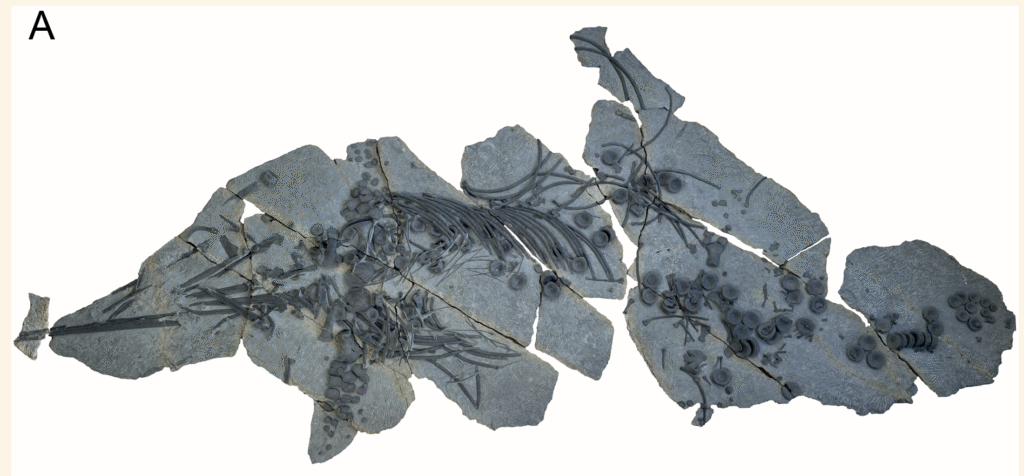
Paleontologists have identified a new species of the marine reptile genus Eurhinosaurus, named Eurhinosaurus mistelgauensis, from Jurassic deposits in Bavaria, southern Germany.
A 60% overbite in the upper jaw
Ichthyosaurs are large, dolphin-like reptiles that thrived in the ancient oceans. Eurhinosaurus is well-known among ichthyosaurs for its distinctive snout, characterized by a dramatic overbite where the upper jaw is far longer than the lower jaw. It can be over 60% longer, in fact.
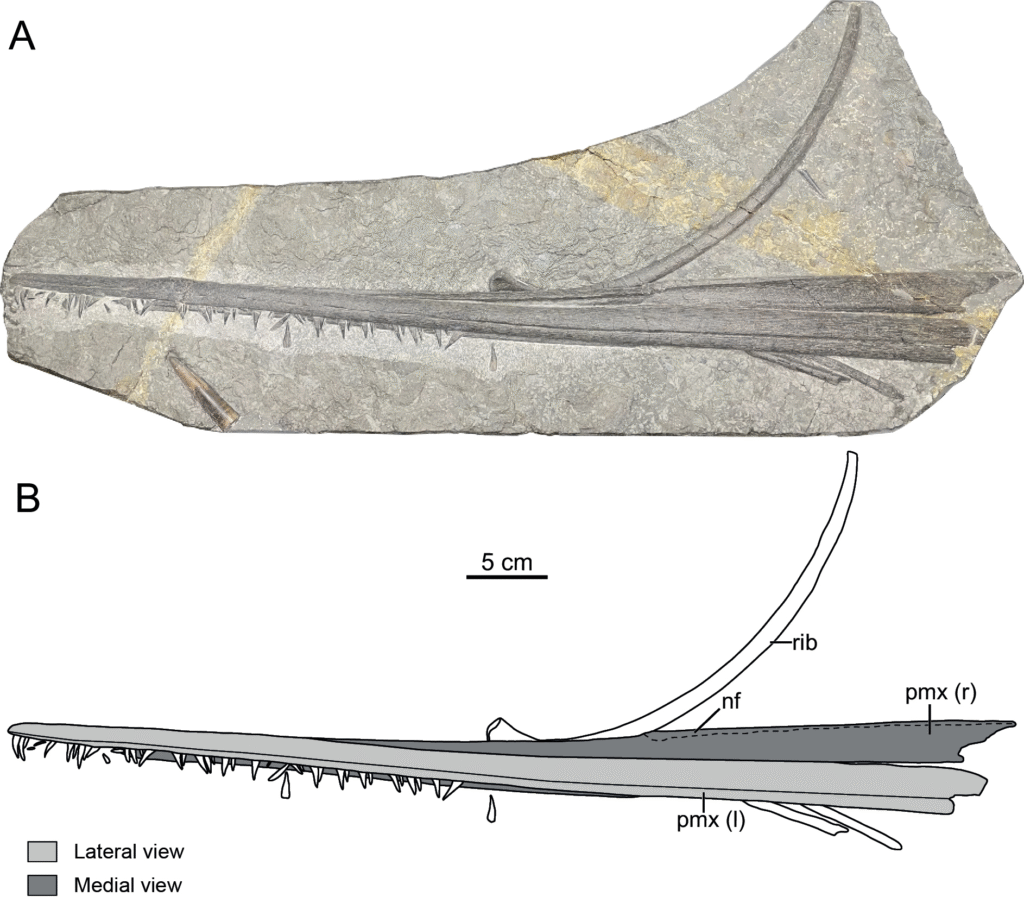
Specimen UMO BT 011 240.00 from Mistelgau. A. Photograph; B. Interpretative line drawing.
This unusual feature likely helped it catch prey in the seas in the Early Jurassic, around 180 million years ago.
The new species was described last month based on three fossils found in the Mistelgau clay pit, in a “belemnite battlefield”. These include two nearly complete skeletons and a partial snout, all remarkably well-preserved in three dimensions.
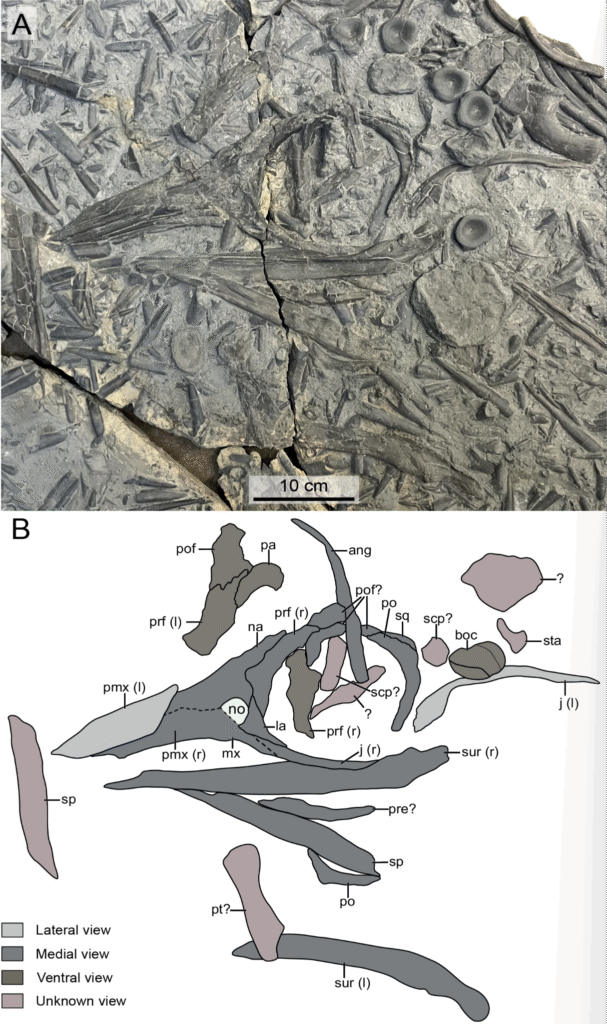
Close-up on the skull of UMO BT 011 235.00. A. Photograph; B. Interpretative line drawing of the cranial bones
Such detailed preservation allows paleontologists to study the anatomy from multiple angles, offering a rare and comprehensive view.
Some of the things they found were significant and diagnostic. For example, Eurhinosaurus mistelgauensis has particularly robust and thick ribs, not just compared to other ichthyosaurs, but even compared to other species in its same genus of Eurhinosaurus. Researchers noted that “none of the previously known Eurhinosaurus specimens exhibit ribs as thick as those in the Mistelgau material.”
“In the Mistelgau specimens, dorsal rib diameters range from 9 mm to 14 mm at midshaft, with the majority exceeding 10 mm”, the researchers noted. “By contrast, in [Eurhinosaurus longirostris], dorsal ribs do not exceed 10 mm at midshaft and are often thinner.”
The youngest Eurhinosaurus with special features
Ichthyosaurs like Eurhinosaurus were highly adapted to life in the ocean. They had elongated bodies, limbs transformed into fins, and powerful tails with fins that made them efficient swimmers, much like modern dolphins.This discovery represents the youngest known occurrence of the Eurhinosaurus genus stratigraphically, meaning it helps fill in important gaps about the evolution and diversity of ichthyosaurs in the Jurassic seas.
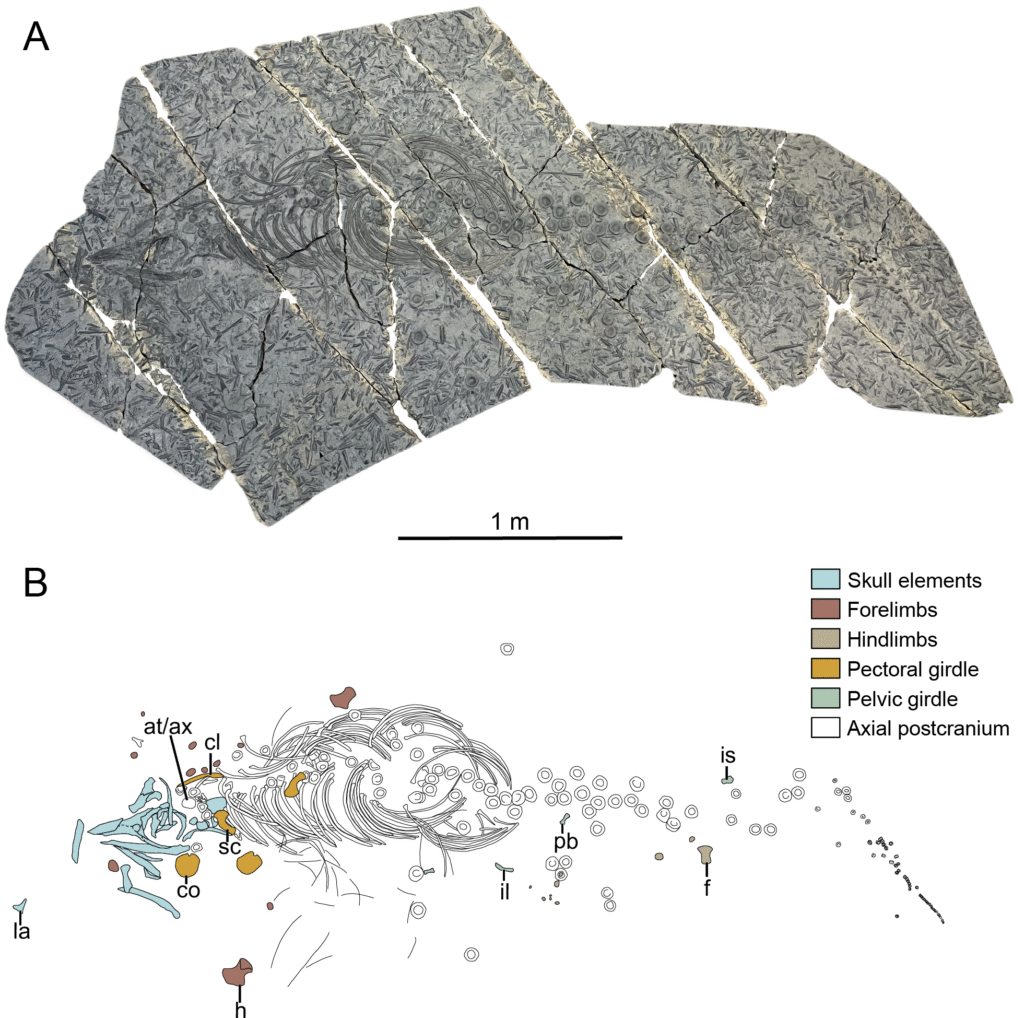
Specimen UMO BT 011 235.00 from Mistelgau. A. Photograph; B. Interpretative line drawing.
The well-preserved specimens shed light on the morphology (shape and structure) of these historical marine reptiles, enriching our understanding of their biology and adaptation to aquatic life.