
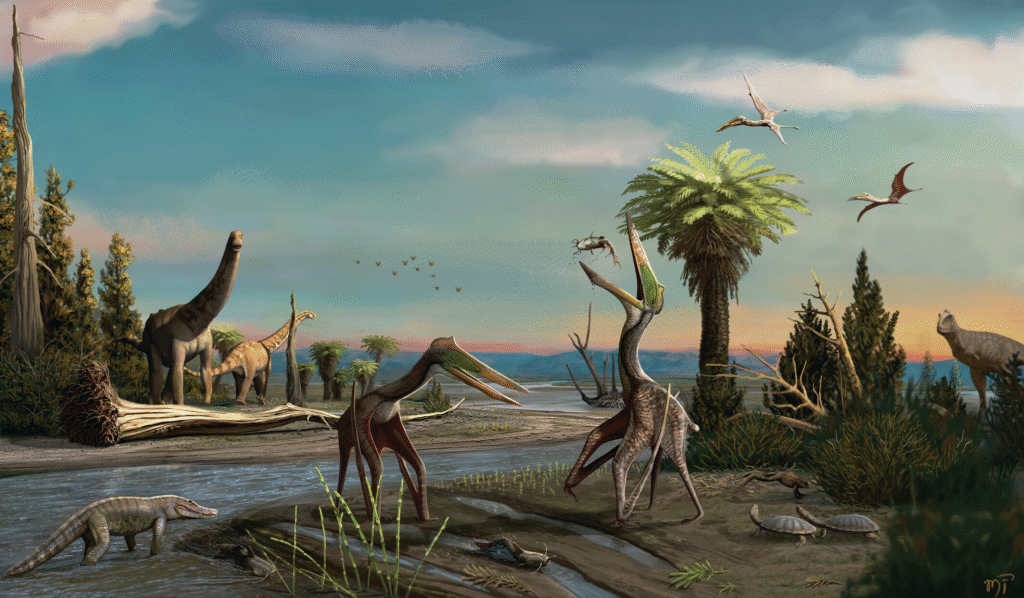
Paleontologists have identified a new species of azhdarchid pterosaur, named Galgadraco zephyrius, from fossil remains found in the Upper Cretaceous Bauru Group of Brazil.
Fossil Discovery in the Serra da Galga Formation
Azhdarchids were a widespread and diverse group of pterosaurs, prehistoric flying reptiles famous as some of the largest creatures to ever take to the air. They lived from roughly 94 to 67 million years ago, favoring inland habitats rather than coastal zones.
Galgadraco zephyrius, described in a paper published last month fits into this lineage. And it expands scientists’ understanding of the group’s geographic distribution in South America.
The key fossil, a fragmentary jawbone, was uncovered in the Serra da Galga Formation, in northern Brazil. This site is known for its rich assemblage of dinosaur fauna, including the sauropod Uberabatitan ribeiroi.
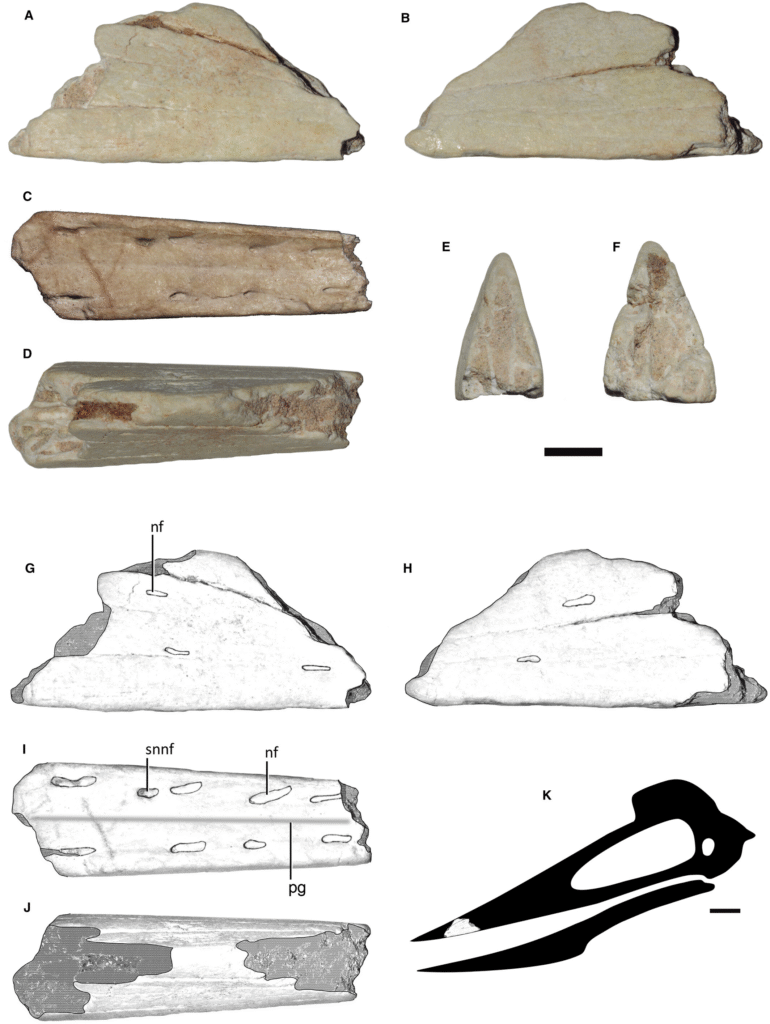
Holotype of Galgadraco zephyrius
Despite the incomplete nature of the specimen, enough distinctive features were preserved to identify it as a new species. The researchers were also able to conduct some limited comparative analysis and hazard a guess that its wingspan was possibly 4-5m long.
Its closest cousins are in Romania
Galgadraco zephyrius displays a unique combination of traits differentiating it from other azhdarchids. Notably, the V-shaped cross-section of its rostrum (snout), low and rounded edges of the jaw (tomial edges), and symmetrically paired rows of small openings (occlusal foramina) are distinctive markers.
These characteristics link the species closely to a contemporary European azhdarchid, Albadraco tharmisensis from Romania. This was concluded by phylogenetic analysis (the method of mapping evolutionary relationships).
This relationship suggests a wider distribution of closely related flying reptiles. It also implies possible dispersal between South America and Europe during the Late Cretaceous.
Prehistoric European connections for flying reptiles
This discovery is significant since it represents the first pterosaur of its kind documented from Brazil. Which means that this discovery fills a major gap in the regional fossil record for flying reptiles.
Before this find, the most recent pterosaur fossils from the Bauru Group dated back to the Lower Cretaceous period, causing a significant temporal gap in the record. Galgadraco zephyrius, living during the Late Maastrichtian (approximately 70 to 67 million years ago), fills this gap and enriches the known diversity of pterosaurs in the region.
Zephyrius hatchlings were also found
The fossil site yielded a diminutive lower jaw that may represent a pterosaur hatchling or very young individual. This was found very close to the adult fossil. That’s a rare occurrence in the fossil record.
This co-occurrence offers a snapshot into the species’ reproductive biology and suggests local breeding populations. The discovery suggests a nesting or juvenile-bearing environment, or at least that juveniles were present in this ecosystem. “This new record enriches the diverse fossil assemblage of the Serra da Galga Formation and sheds light on the palaeoecology of this important unit of the Brazilian Upper Cretaceous and the azhdarchid diversity during the Maastrichtian.”, the researchers wrote.