
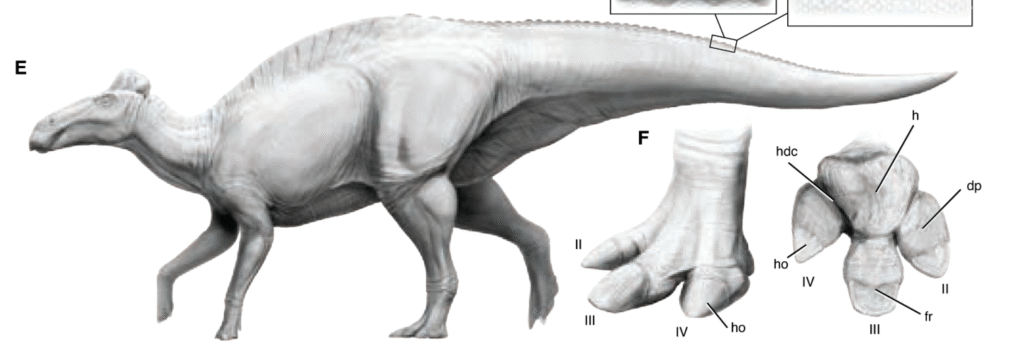
Paleontologists have unveiled two exceptionally preserved “mummy” specimens of Edmontosaurus annectens, a well-known duck-billed dinosaur from the end-Cretaceous. These discoveries, made in the fossil-rich badlands of Wyoming, gave researchers the most complete reconstruction yet of this large herbivore’s life appearance.
Mapping the “Mummy Zone”
The research team, led by Paul Sereno at the University of Chicago, traced the excavation sites of legendary dinosaur mummies first discovered over a century ago. By returning to this “mummy zone”, they uncovered one adult and one juvenile Edmontosaurus with lots of skin still intact. Their findings were published last month.
The most likely scientific explanation for why so many mummy dinosaurs have been found in this area is a “rapid subsidence in a coastal setting subject to seasonal drought-flood cycles.”, according to the authors. Whatever the reason, Edmontosaurus annectens and hadrosaurids in general have accounted for most dinosaur mummies in the region. This leads scientists to wonder, “Is there something special about hadrosaurid skin or the “mummy zone” that favored integument preservation?”
A Crest, Spikes, and Unexpected Hooves
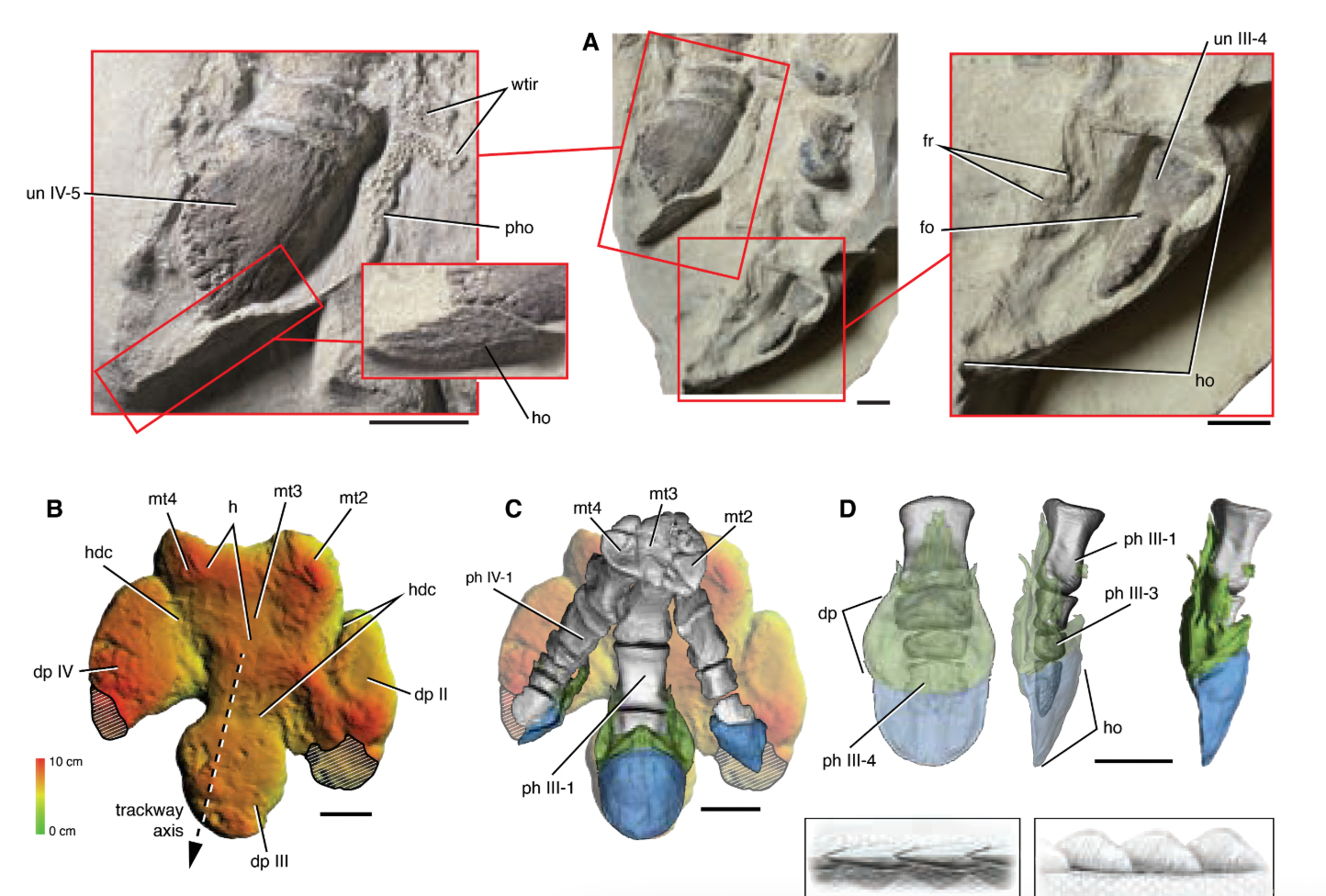
(A) Distal ends of right pedal digits III and IV in lateral and dorsolateral views, respectively, with enlarged views of the last phalanges, scaly skin, hoof cross-section and hoof surface texture of digit IV (left) and the last phalanx and hoof cross-section of digit III (right) (UCRC PV30).
(B) Relief map of a natural cast of a hadrosaurid right pedal footprint from the St. Mary River Formation (Maastrichtian) of Alberta. (C) Bones, partial hooves, and digital pads of the right pes of an early adult of E. annectens in dorsal view. Enlarged 15%) superposed over the natural cast of a right pedal footprint (TMP 87.76.6). Hooves in blue; digital pads in green. (D) Hoof and digital pad of right pedal digit III in translucent ventral (left), translucent lateral (middle) and opaque lateral (right) views. Hooves in blue; digital pads in green.
For the first time, paleontologists could reliably recreate the full outline of Edmontosaurus. It had a continuous fleshy crest, which began at the neck, and ran along the trunk. This crest then transformed into a row of spikes down the tail. Each spike was perfectly perched atop a vertebra. Covering its lower body and tail were tiny, pebble-like scales.
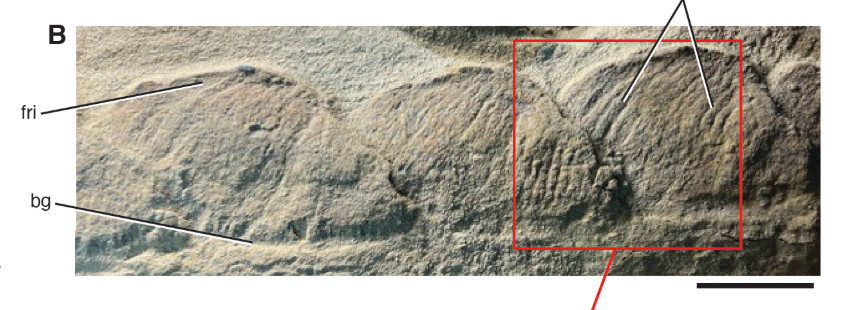
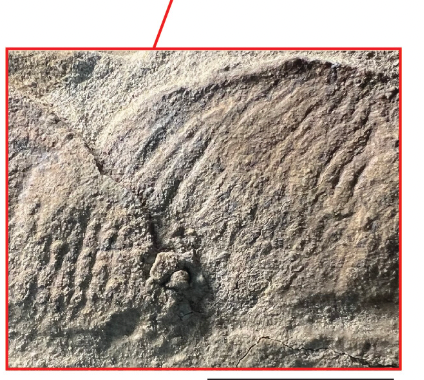
Spikes of mid caudal vertebrae (CA32–34) in lateral view (reversed) with an enlarged view (bottom) of interdigitation between successive spikes (over CA33, 34).
But the most startling feature was true hooves on the hind feet. Scientists conducted CT scans and also made comparisons with fossilised footprints. They found that the tips of the three hind toes were encased in wedge-shaped, flat-bottomed hooves. These hooves are remarkably similar in design to those of modern horses. Each hind foot also had a fleshy pad behind the hooves, different from the posture of the front feet.
A species of many “firsts”
These specimens are packed with evolutionary significance. The Edmontosaurus “mummies” reveal the first clear example of hooves in any land-living vertebrate. This makes it the earliest known hooved four-legged animal and the first ever hooved reptile.
Other features, like differences in the posture between front and hind limbs, also stand out as unique evolutionary solutions. Professor Sereno and team describe these findings as full of amazing firsts. “The late juvenile is the first subadult dinosaur mummy on record and the first large-bodied dinosaur preserving the fleshy midline over the trunk. The early adult is the first hadrosaurid to preserve the entire spike row from hips to tail tip and the first reptile preserving wedge-shaped pedal hooves”