India’s First Silesaurid Is a Dinosaur Cousin With Forward-Jutting Teeth
Indian paleontologists have identified the first definitive silesaurid from India, a close relative of the dinosaurs (but not exactly a dinosaur). The fossil, an incomplete skull with its lower jaw still attached, comes from the Tiki Formation in the Rewa Basin of Madhya Pradesh and has been named Rewasaurus minori.
The new species is described in a paper published last month in The Anatomical Record by Sulagna Sen, a paleontologist in the Department of Geology and Geophysics at the Indian Institute of Technology (IIT) Kharagpur, with co-authors Pranil Basu and Sanghamitra Ray. The genus name refers to the Rewa Basin, while minori nods to the animal’s small size compared with other silesaurids.
Triassic Times only managed to read the abstract of the paper (the paywall is $10, which is $10 above our budget), so we are guesstimating that the age of the fossil is approximately 230–220 million years – this is consistent with what we know about the Tiki Formation in the Rewa Basin.
Silesaurids are not exactly dinosaurs
Silesaurids were lightly built, mostly four-legged animals that lived alongside the earliest dinosaurs during the Triassic. Named after Silesaurus from Silesia in Poland, they have turned up in Europe, North and South America, and Africa. Until now, India had no confirmed member of the group. That’s why this discovery is significant.
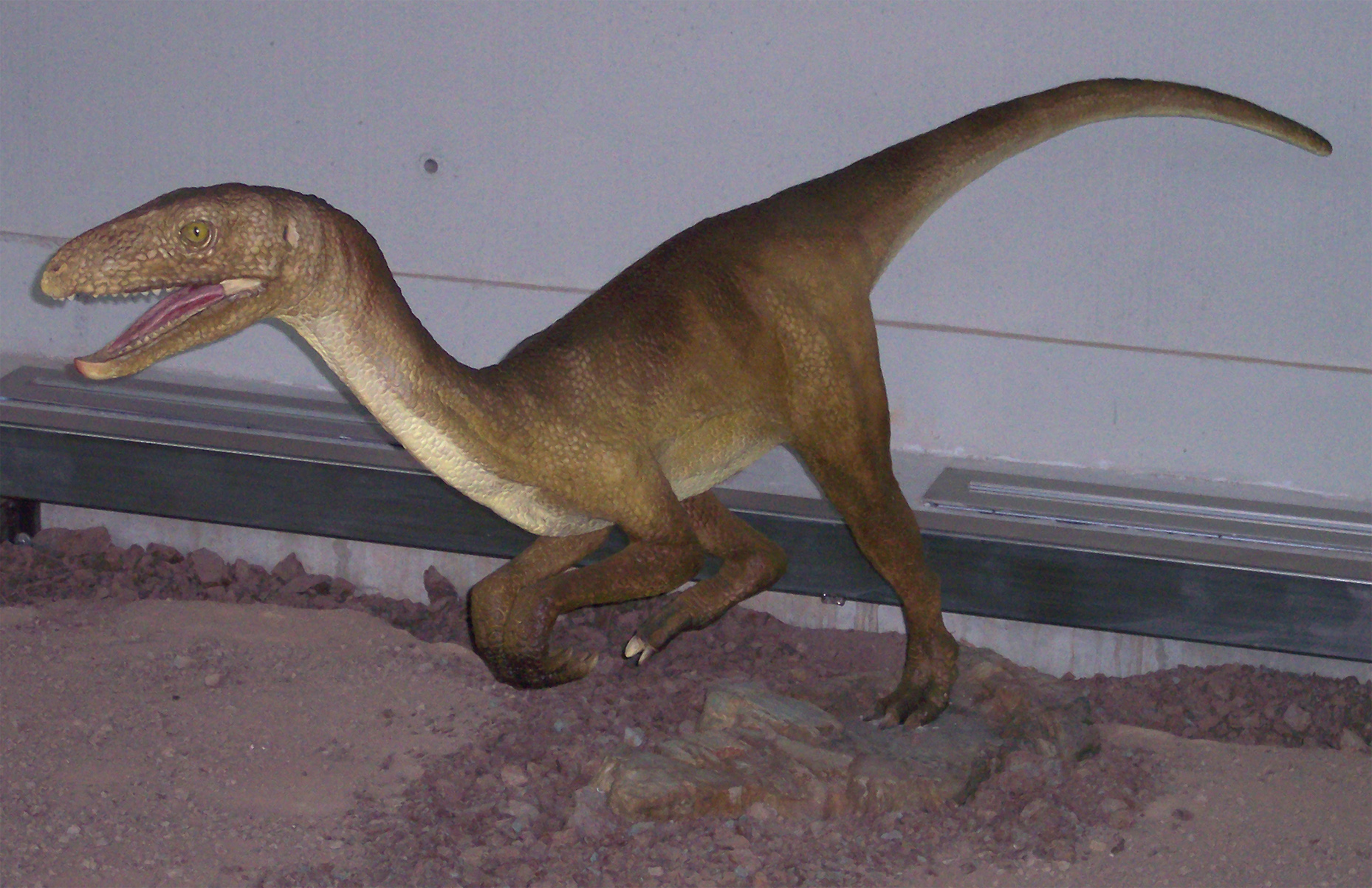
Life restoration of Silesaurus opolensis, the Polish silesaurid that gave the group its name, at the JuraPark in Krasiejów, Poland. Image credit: Konrad Kurzacz / CC BY-SA 3.0, via Wikimedia Commons
There are two anatomical technicalities, because of which these animals are not considered “true dinosaurs”. The first is that their hip socket kept a bony inner wall, whereas dinosaurs have an open, perforated socket.
The second one, which will become important in a moment, is that their teeth also eventually fused to the jaw bone, rather than staying suspended in their sockets by a ligament as they would in a dinosaur’s mouth.
A mouthful of unusual teeth for Rewasaurus
What sets R. minori apart is its teeth, according to the paleontologists. The premaxilla (the bone at the very tip of the upper jaw) held five teeth, and the front three were cylindrical and procumbent (pointing forwards rather than straight down). Its upper tooth row is described as being proportionally shorter than the lower one, and the tip of the dentary (the main lower-jaw bone) as sitting almost level with the rest of the tooth-bearing edge.
The team thinks this arrangement worked as a grasping tool. They suggest “a grasping feeding apparatus adapted for exploiting easily processed soft-bodied preys and plant material available in the Tiki floodplains”. In other words, Rewasaurus was probably an opportunistic omnivore, snapping up soft-bodied animals and plants rather than tackling tough food.
Two partial femora (thigh bones) were also recovered from the same rock layer, but at a different site. They also came out as silesaurid in the analysis, but because they share no overlapping bones with the skull, the researchers could not confidently assign them to Rewasaurus.
The fate of the silesaurid
The researchers also built a time-calibrated family tree, which suggests silesaurids went through two major phases of diversification and spread both eastward and northward across the supercontinent Pangaea, with the eastward spread beginning considerably later.
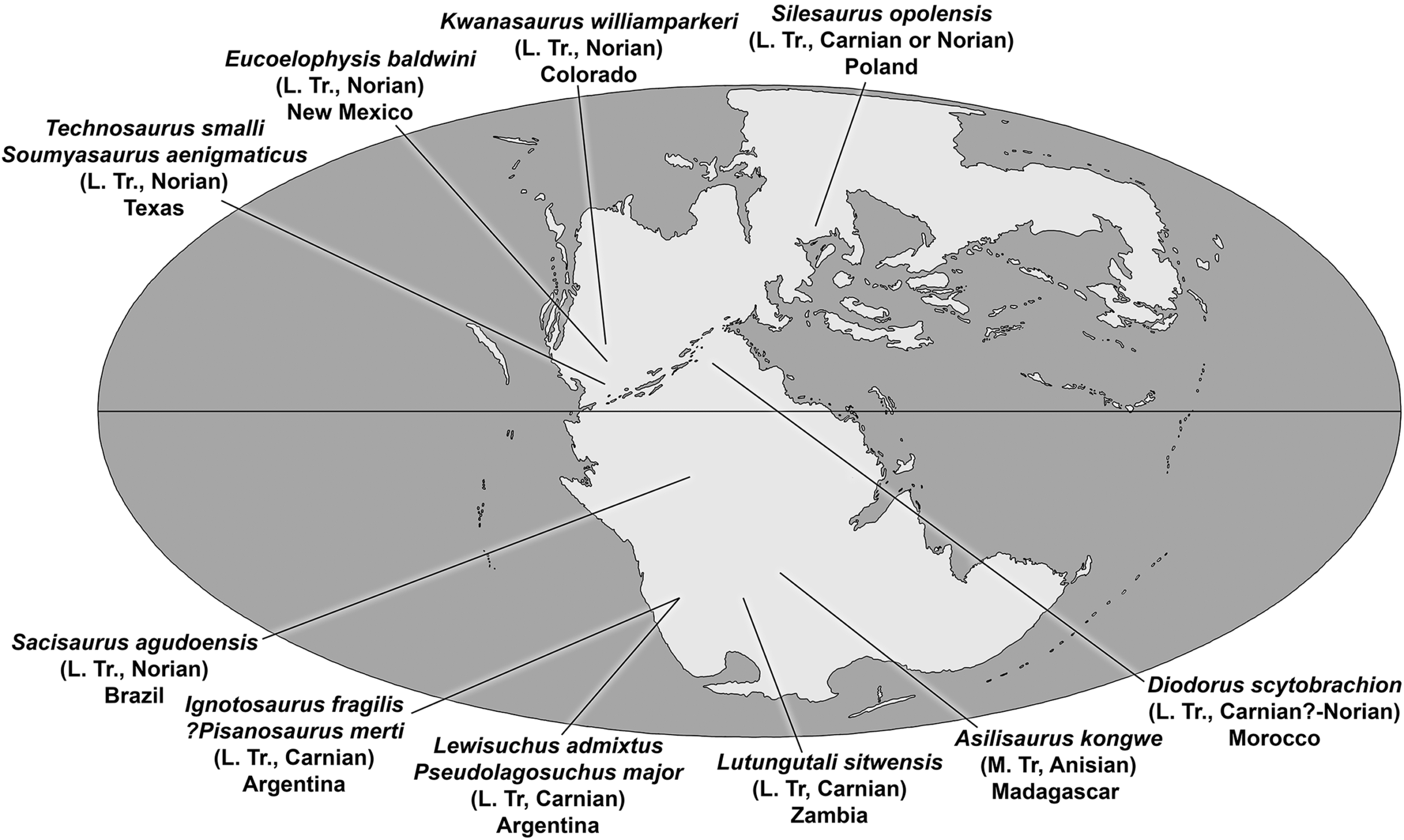
Silesaurid finds known before Rewasaurus, plotted on a Middle–Late Triassic map of Pangaea. India is not marked because the map predates the new discovery. Image credit: Martz & Small (2019), PeerJ, doi: 10.7717/peerj.7551 / CC BY 4.0
As you can see, they’re pretty spread out, but exactly where silesaurids sit on the family tree is a bit of a debate in early dinosaur research, by the way. Some studies treat them as a separate group just outside the dinosaurs, while others place them among the earliest ornithischians (the “bird-hipped” dinosaur lineage that later produced Triceratops and Stegosaurus).
They also note that silesaurids are strikingly scarce in the final stage of the Triassic, roughly 205 to 201 million years ago. That gap “may be associated with global environmental perturbation across the Norian–Rhaetian Boundary,” the researchers wrote, hinting that climate change may have hit these dinosaur cousins well before the end-Triassic mass extinction.