
3.5-Billion-Year-Old Rock From Jharkhand May Be the Oldest Directly Dated Trace of Life
Geologists have directly dated what they interpret as the remains of a microbial mat to about 3.5 billion years ago, in a banded rock called the Bhitardari chert, from the Singhbhum Craton in Jharkhand, eastern India. Volcanic zircon crystals in the chert rock give it an age of 3,497 ± 5 million years. The study was published in Proceedings of the National Academy of Sciences on 17 August 2026 (paper). The authors call it, to their knowledge, “the oldest directly dated rock with a confirmed biosignature.“
Dating the undatable
Chert, a hard, silica-rich rock, is good at preserving ancient organic matter but is notoriously hard to date directly. This is because chert is mostly silica, which usually contains too little of the radioactive elements needed for reliable radiometric dating. Accordingly, ages usually come from rocks that cut through or sit above them.
“Recovery and dating of zircons from Precambrian cherts is exceptionally rare because these rocks generally contain little volcanic or detrital material and zircons are typically very small,” the researchers wrote.
In this case, the team crushed about 1.5 kg of the rock and recovered tiny zircons from inside the rock, 40 to 60 micrometres long, which they interpret as volcanic ash that settled while the chert was forming. Four of the eight zircons gave consistent results, yielding an age of 3,497 ± 5 million years, which the authors interpret as the age of the rock. The other four gave discordant results (their two radioactive clocks disagreed). The authors attribute this largely to radiation damage that could have allowed some lead to escape.
A carbon fingerprint
Under the microscope, the rock shows rhythmic, submillimetre-scale layers that alternate between quartz and carbon-rich material, a texture the team compares to a microbial mat. The carbon occurs in two forms: ultrafine layers within the original rock, and coarser graphite flakes in quartz veins that formed much later.
Raman spectroscopy (a laser technique that reveals how ordered the carbon is) showed that the layered carbon is structurally disordered and reached a peak temperature of only about 337 °C. According to the authors, this is consistent with original organic matter that survived metamorphism, rather than later contamination. The vein graphite, by contrast, was altered by hot fluids at much higher temperatures.
The researchers interpret the carbon’s isotopic signature as biological, because it is typical of carbon fixed by living cells. Researchers argued that these signatures are “consistent with the rise of relatively sophisticated metabolic mechanisms (e.g., Calvin cycle) by 3.5 [billion years ago].“
How strong is the case to be the oldest?
Claims about Earth’s earliest life are notoriously contested. Graphite in 3.7- to 3.8-billion-year-old rocks from Greenland, for example, has been disputed, and the authors acknowledge that abiotic processes can mimic biological signals. The Bhitardari case rests on chemistry, texture and geological setting rather than on recognisable microfossils, which the paper does not report.
Other sites of similar age, including those in Western Australia’s Pilbara Craton and South Africa’s Barberton Greenstone Belt, preserve stromatolites and microbial structures. Their ages can be established using associated volcanic deposits or constrained by surrounding rock layers.
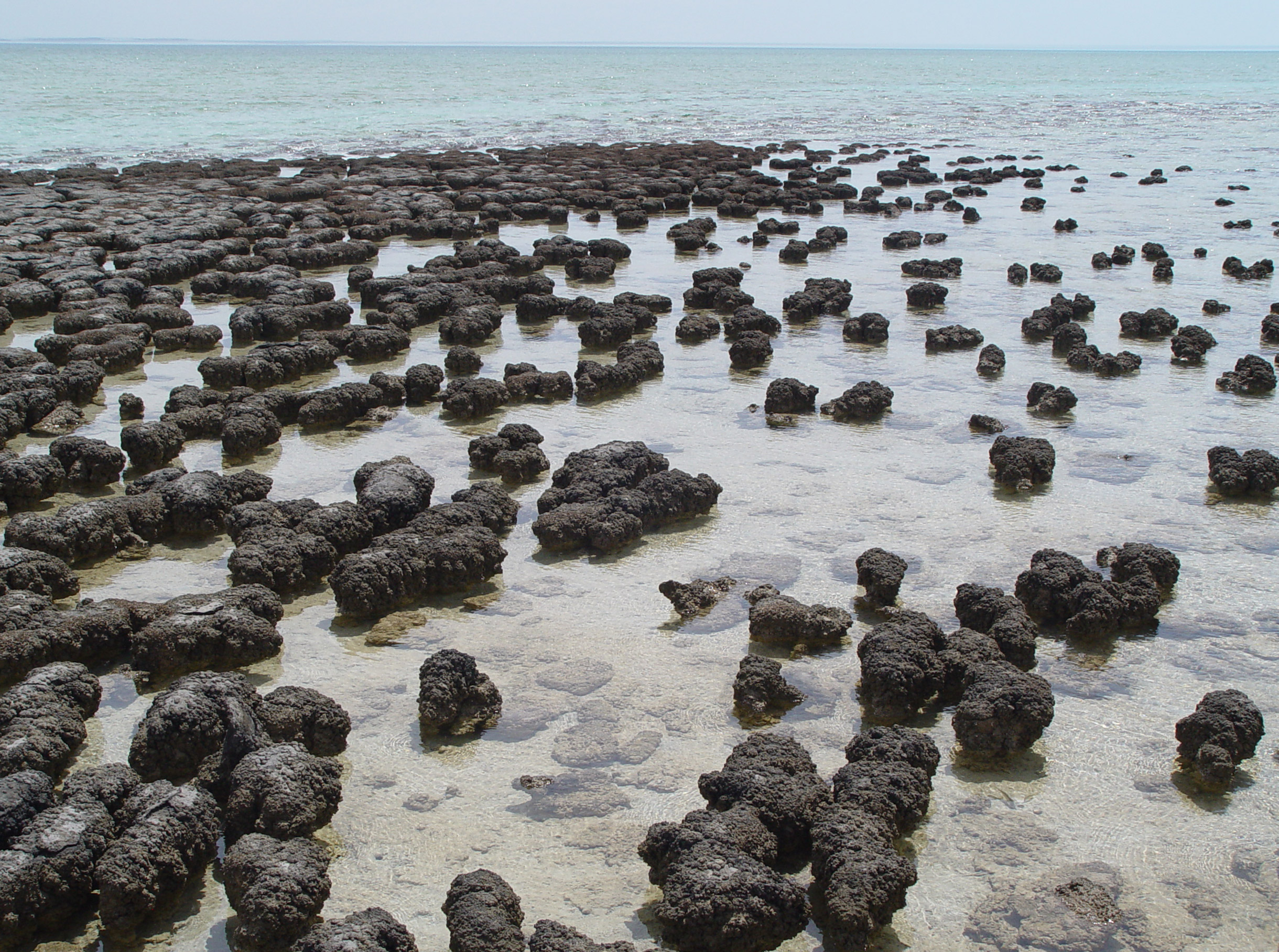
Modern stromatolites at Hamelin Pool, Shark Bay, Western Australia, shown for comparison; this is not the Bhitardari chert or the studied material. Image credit: Paul Harrison / CC BY-SA 3.0 (unmodified).

Here, the dated zircons came from the carbon-bearing chert itself. Even so, the age rests on an interpretation: the four zircon grains must have come from volcanic ash deposited as the chert formed, rather than older material washed in. Independent work will need to test both the date and the biological reading of the carbon.
For India, the find adds the Singhbhum Craton, already home to some of the country’s oldest crust, to the short list of places that may preserve Earth’s earliest ecosystems. The authors conclude that their observations “provide compelling evidence of sustenance of early life in volcanism-associated, iron- and silica-rich marine environments that constituted viable habitats for some of Earth’s earliest microbial ecosystems.“
Lead author Trisrota Chaudhuri works at the Secondary Ion Mass Spectrometer (SIMS) Laboratory of the Geological Survey of India (GSI) in Kolkata. Her co-authors are T. Mark Harrison and Elizabeth Bell of the University of California, Los Angeles (UCLA), with colleagues at Naturalis Biodiversity Center in the Netherlands, Ifremer and CNRS in France, the German University of Technology in Oman and the National Institute of Advanced Studies in Bengaluru.