
India’s First Leptosuchomorph Is a Crocodile Look-Alike From Telangana’s Triassic
Leptosuchomorphs are a kind of reptile that fall within the larger phytosaur group. Phytosaurs are crocodile-like creatures that are not very closely related to crocodiles (they’re much more ghariyal-like, actually, but we have to appeal to an international audience).
Phytosaurs are known from India, but Primisuchus gillettei is India’s first leptosuchomorph phytosaur. “The Upper Triassic of India preserves a rich record of phytosaurs, encompassing both early- and later-diverging parasuchids”, the researchers wrote. This is probably the only sentence in the abstract that we could understand first time, so this is the only quote we will be using for this article.
Paleontologists identified Primisuchus from an incomplete skull found in Late Triassic rocks of the Maleri Formation in Telangana’s Pranhita–Godavari Basin. The fossil is described in a paper published in September. The abstract doesn’t reveal their age, and we can’t afford the full paper, but the fossil’s presence in the Maleri Formation indicates an age of ~220 million years.
A skull with a crest
The fossil is an incomplete skull. The team diagnoses the new species from a combination of features. These include a tripartite upper-jaw dentition (which means the upper teeth fall into three distinct sections), a narial crest (a raised ridge around the nostrils) and nostrils that overlap the antorbital fenestra, the opening in front of the eye.
The back of the skull is distinctive too. There is a pair of fossae (shallow depressions) on the parietal bone that meet along a raised median wall, and a deep pit on the shelf where the parietal meets the supraoccipital. Phytosaurs carried their nostrils high on the head, near the eyes, so details of the snout and skull roof matter a great deal in telling species apart.
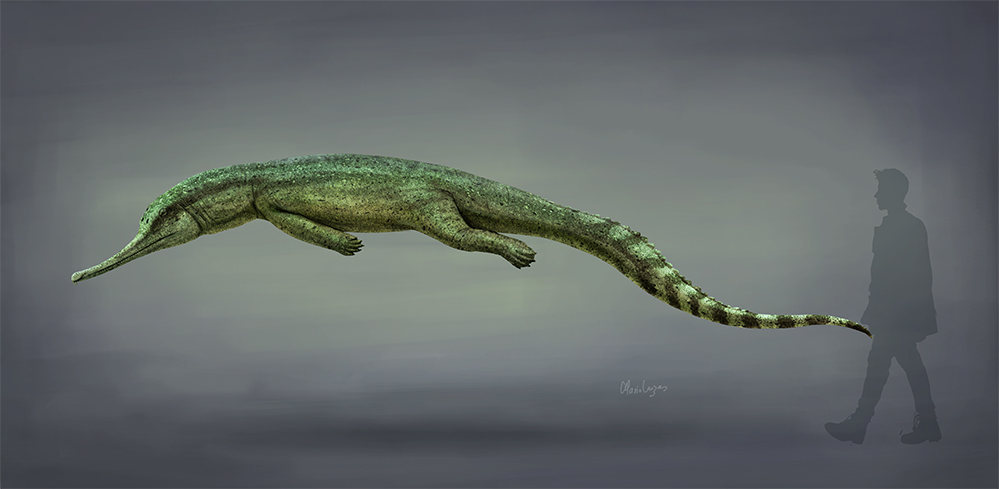
Life reconstruction of Mystriosuchus, a mystriosuchin phytosaur. Phylogenetic analysis places Primisuchus gillettei as the sister taxon to Mystriosuchini, so this is a close relative rather than the Indian fossil itself. Image credit: Mario Lanzas / CC BY-SA 4.0, via Wikimedia Commons
A new marker for Triassic time
Phytosaurs are widely used to correlate Late Triassic rocks between continents, which means that by comparing Primisuchus with phytosaurs found elsewhere, geologists can better assess how the age of India’s fossil-bearing rocks matches that of rock layers on other continents. Primisuchus can give Indian geologists a new reference point.
The new fossil can also help reconstruct how phytosaurs spread. The researchers suggest the group originated between about 247 and 237 million years ago. Early parasuchids became widespread across the world roughly 232–227 million years ago, as a spell of unusually wet climate and environmental upheaval was ending. Then, a climate-driven change in animal communities saw phytosaurs outside the leptosuchomorph group disappear.
Leptosuchomorphs, like Primisuchus gillettei, then diversified within individual regions before spreading between continents again, roughly 216–206 million years ago. Leptosuchomorphs were the last surviving phytosaurs, but they didn’t survive the Triassic-Jurassic boundary, going extinct about 201 million years ago.
India seems to be researching phytosaurs
It has been a busy year for Indian phytosaurs. In February, IIT Kharagpur researchers reported widespread bone infection in a young community of the phytosaur Colossosuchus techniensis from Madhya Pradesh, India, in a separate study. Stay tuned for a belated article about that.
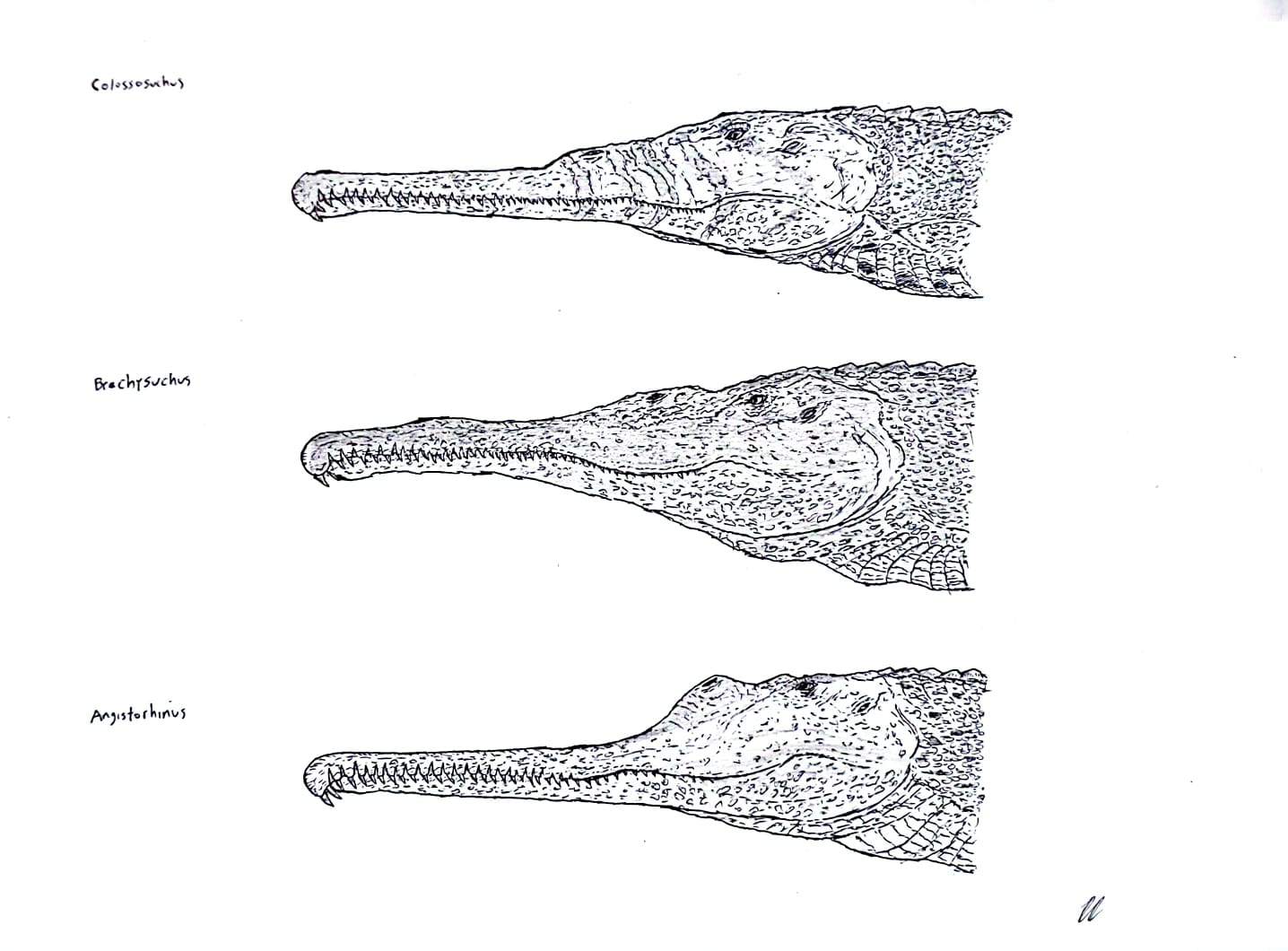
Comparative reconstruction with Colossosuchus (top), the giant Indian phytosaur from Madhya Pradesh’s Tiki Formation that featured in the February infection study, above relatives Brachysuchus and Angistorhinus. Not Primisuchus. Image credit: Daeng Dino / CC BY-SA 4.0, via Wikimedia Commons
Lead author Debajit Datta, of the Department of Geology and Geophysics at the Indian Institute of Technology (IIT) Kharagpur (now at IIT Roorkee), worked with Sulagna Sen and Sanghamitra Ray of IIT Kharagpur and with Debarati Mukherjee and Saswati Bandyopadhyay of the Geological Studies Unit at the Indian Statistical Institute (ISI), Kolkata.