A “small” 7-metre Sauropod From India May Be One of the Earliest Neosauropods
Paleontologists have identified Ceratocaudia antiqua, a small sauropod dinosaur about 7 metres long with a horn-like crest on its tail. We’ll tackle the idea that 7 metres is considered “small” in the sauropod world in this article. C. antiqua was found in the Kaladongar Formation in Gujarat’s Kutch Basin, in rocks assigned an uncertain Early to Middle Jurassic age, roughly 193–168 million years ago.
Horny tail, corny tale
The holotype is a partial skeleton, published on 16 July 2026, and more fragmentary bones from the same rock layers at a nearby site have also been referred to the species. Sci.News reports that the excavation yielded 181 fragments, including vertebrae, ribs and limb bones, all thought to come from one individual.
The genus name means “horned tail”. It refers to the animal’s most striking feature, a horn-like crest on the neural spine (the upward projection) of a vertebra near the base of the tail.
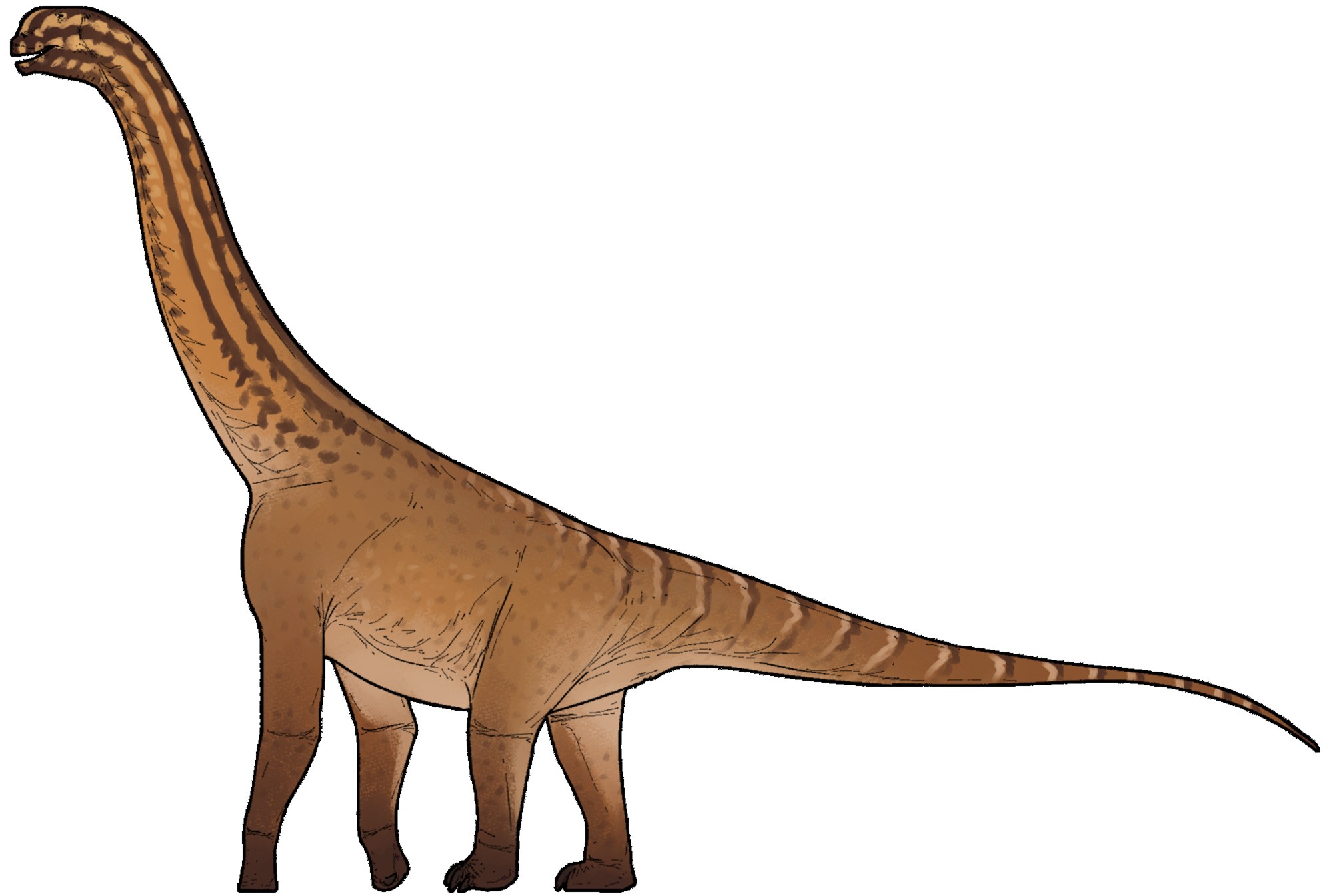
A life reconstruction of Ceratocaudia antiqua, a roughly 7-metre sauropod from the Jurassic of Kutch with a horn-like crest on its tail. Image credit: Connor Ashbridge / Wikimedia Commons / CC BY 4.0

Other features unique to the species include a notch on a neck vertebra, an unusual split joint surface on a chevron (one of the small bones beneath the tail), and distinctive shapes in the lower leg bones. Further down the tail, the vertebrae shift from flat-ended joints to ball-and-socket (procoelous) ones.
The team used reconstructed bones to model the tail’s muscles. The model suggested that the tail could have served “as a mild deterrent to predators”, the researchers wrote.
Small, and old for its kind
At about 7 metres, C. antiqua was small by sauropod standards. Other sauropods of around the same stretch of the Jurassic were more than twice as large. For example, Australia’s Rhoetosaurus was about 15 metres, and Argentina’s Patagosaurus was about 16–18 metres. India’s own early sauropods from the Kota Formation, Kotasaurus and Barapasaurus, were about 9 and 14 metres. And if you want the largest sauropod ever, that’s Argentinosaurus, at 30-35 metres, but it lived many many millions of years later. (Multiply everything by 3.3 for feet, if you’d like, by the way)
Bone histology (the study of bone microstructure) and signs of non-traumatic, non-contagious pathology indicate the holotype animal was an old dude near the end of its life, rather than a juvenile.
An early macronarian from India
“Ceratocaudia antiqua is the earliest diagnosable macronarian neosauropod from India and represents one of its earliest global occurrences,” the researchers wrote. Other well-known macronarian neosauropods are the Camarasaurus from the US and the titanosaurs.
Some coverage has gone further than the paper. The Independent called Ceratocaudia “the oldest known neosauropod” and roughly 10 million years older than previous records. Note the authors of the paper themselves say only that it is “one of” the earliest, and its age range is not exactly defined. So please verify any age-related claims Independently (you get it).
The find adds to a short list of Jurassic sauropods from India, best known from the Early Jurassic Kota Formation’s Barapasaurus tagorei and Kotasaurus yamanpalliensis. If its age can be figured out more accurately, the little horn-tailed sauropod from Kutch could become a key reference point for when the lineage of the largest land animals began to spread.
Lead author Abhishek Natarajan, of the Department of Earth Sciences at the Indian Institute of Technology (IIT) Bombay, worked with IIT Bombay colleagues Suraj Bhosale, Nibedita Rakshit and Sudipta Dasgupta. The skeleton is reported to have been excavated near Amrapar village on the Khadir Uplift and is housed in IIT Bombay’s Vertebrate Palaeontology Lab.