Kashmir Jaw Reveals the Most Primitive Whale Yet Found
A 48-million-year-old jawbone from the Himalayan foothills belongs to the most primitive whale identified to date, according to an international team of paleontologists. The new species, Kalakocetus aurorae, comes from the Kalakot area of Jammu and Kashmir, India, and its teeth capture a step in whale evolution that had never been seen before.
The species is described in a paper published on 27 April in Nature Ecology & Evolution. The lead author of the paper, Mohd. Waqas collected the fossil in his home district of Rajouri. The genus name means “the cetacean from Kalakot”.
Pay Attention To The Teeth
Whales evolved from land-dwelling even-toed hoofed mammals, and their closest known relatives are the raoellids, small plant-eaters whose molars carried four main cusps for crushing and grinding. By the time the earliest known whales such as Pakicetus appear, those molars had already been pared down to slicing teeth dominated by two sharp cusps.
Whale skeletons document the move from land to water step by step, but their “highly derived carnivorous teeth appear abruptly in the fossil record,” the researchers wrote.
Like a good dentist, Kalakocetus has filled the tooth gap.
The holotype is a fragmentary left half of the lower jaw from a fully adult animal, preserving the second and fourth premolars and the first and third molars. Its first molar still has four cusps, but the third has only three.
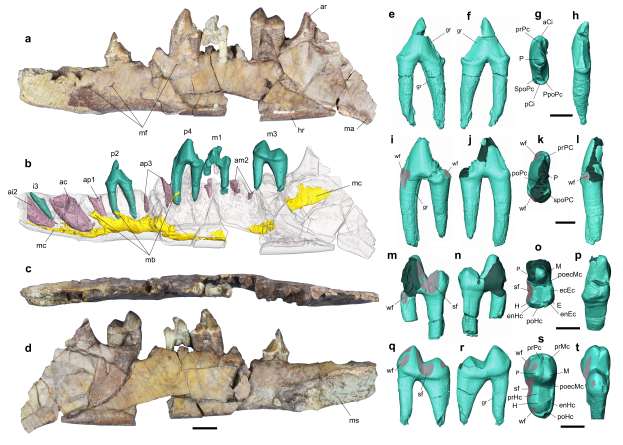
The fragmentary left lower jaw of Kalakocetus aurorae (GU/RJ/07) from Kalakot, Jammu and Kashmir, with 3D reconstructions of its premolars and molars; its three-cusped third molar sits midway between land-mammal and early-whale teeth. Image credit: Waqas et al. (2026), author version via HAL / CC BY 4.0 (Fig. 1 of the author version; unmodified)
“Its unprecedented dental morphology bridges the gap between the shearing molars of early carnivorous cetaceans and the crushing molars of their closest terrestrial relatives,” the researchers wrote.
The team’s phylogenetic analysis places K. aurorae as the first branch to split off the whale family tree, a position backed by nine unambiguous shared features of the jaw and teeth, and they have created a new family, Kalakocetidae, for it. The same site has also produced teeth of a raoellid and of several rodents, which basically means that early whales and their closest land cousins turned up in the same place.
A Meat-Eater From the Start
To work out how the animal fed, the researchers scanned the teeth in 3D, measured their surface shape and studied microscopic wear. The third molar has greater relief and sharpness, and less complexity, than those of raoellids, and its microwear shows deep parallel scratches like those of Pakicetus inachus. The team concluded that Kalakocetus ate meat, used a shearing jaw movement, and had already lost the crushing function of its third molar.
“This fossil suggests that the first cetaceans started shifting towards a meat-based diet very early in their evolution, probably in parallel with their adaptation to aquatic environments,” co-author Weppe said in a press release from the Institute of Natural Sciences. In an article written in French (et je ne parle pas beaucoup de Francais), Weppe describes it as an animal about the size of a small wolf.
Let’s Go, Kalakot
“This makes Kalakocetus aurorae the most primitive cetacean identified to date,” Weppe said. The Kalakot region has long been a key hunting ground for early whales and their relatives, and this find is important to our understanding of the early evolution of whales.
“The intermediate morphology of K. aurorae provides the missing element critical to the understanding of the emergence of the carnivorous dental pattern of cetaceans,” the researchers wrote. With only one jaw known, more fossils will be needed to show what the rest of the animal looked like. 3D models of the jaw are freely available on MorphoMuseuM.